Department of Nutrition and Dietetics, High School of Arnhem and Nijmegen, Nijmegen, The Netherlands
Received 31 March 2011; accepted 25 August 2011.
Article Outline
Abstract
Given the large social impact of dietary advice, it is important that the advice have a solid scientific basis. Evidence-based dietary advice should be built on results from all studies available, according to a given methodology. Conclusions should be a valid representation of the summarized results. The association between saturated fat intake and cardiovascular disease was examined. Results from three reports of leading U.S. and European advisory committees were compared with results as they were presented in the articles referred to. Findings were put into perspective with results not included in these reports. Different lines of evidence were included in the different reports. No overlap whatsoever was found in the articles included. Most results from the scientific literature were lacking for most different lines of evidence in all reports. All three reports included the effect of saturated fat on low-density lipoprotein cholesterol in the evidence linking saturated fat to cardiovascular disease, but the effect on high-density lipoprotein cholesterol was systematically ignored. Both U.S. reports failed to correctly describe the results from the prospective studies. Results and conclusions about saturated fat intake in relation to cardiovascular disease, from leading advisory committees, do not reflect the available scientific literature.
Introduction
Consumption of saturated fat increases levels of low-density lipoprotein (LDL) cholesterol
[1]. LDL cholesterol has been positively associated with cardiovascular disease (CVD) risk
[2]. These findings have led to worldwide recommendations to decrease the consumption of saturated fat to decrease the risk of CVD. The dietary guidelines, published by the U.S. Department of Agriculture (USDA) and the U.S. Department of Health and Human Services (USDHHS) in 2010
[3], have been criticized for being based on an incomplete body of relevant science and for inaccurately representing or summarizing the science on saturated fat in relation to CVD
[4].
To examine the possible inconsistencies between findings in the scientific literature and the dietary advice relating saturated fat to CVD, results from three reports by important U.S. and European advisory committees were compared with findings in the scientific literature. The reports included that by the USDA/USDHHS report, a report about dietary fats from the Institute of Medicine (IOM) in 2005
[5], and a report about dietary fats from the European Food Safety Authority (EFSA) in 2010
[6].
Recommendations from the advisory committees are as follows:
•Consume less than 10% of calories from saturated fatty acids by replacing them with monounsaturated and polyunsaturated fatty acids (MUFAs and PUFAs) [3].
•Keep the intake of saturated fatty acids as low as possible while consuming a nutritionally adequate diet [5].
•Saturated fat intake should be as low as possible [6].
The advisory committees included three types of studies as support for their recommendations:
1.Controlled trials that showed that saturated fat consumption increases (LDL) cholesterol levels.
2.Intervention studies that showed that the decrease of saturated fat and the simultaneous increase of polyunsaturated fat in the diet decrease CVD risk.
3.Prospective cohort studies that showed a positive association between saturated fat intake and coronary heart disease (CHD) risk.
Not all advisory committees included all three types of studies in their results.
Table 1 lists the types of studies used as evidence and the number of studies included in the results from each type of support.
Table 1. Overview of criteria used to judge the relation between saturated fat and CVD disease in three different reports from advisory committees
| Discussed findings | IOM, 2005 | USDA/USDHHS, 2010 | EFSA, 2010 |
|---|
| Saturated fat increases serum LDL cholesterol | yes | yes | yes |
| Saturated fat increases serum HDL cholesterol | yes | no | yes |
| Effect of serum LDL cholesterol on CVD included when judging the evidence | yes | yes | yes |
| Effect of serum HDL cholesterol on CVD included when judging the evidence | no | no | no |
| Controlled trials of dietary fats in relation to serum cholesterol included when judging the evidence | yes (n = 27) | yes (n = 11) | yes (n = 60) |
| Systematically reviews controlled trials about saturated fat in relation to serum cholesterol | no | no | Yes |
| Randomized trials of substitution of polyunsaturated fat for saturated fat included when judging the evidence | no | no | yes (n = 7) |
| Systematically reviews randomized trials about substitution of polyunsaturated fat for saturated fat | no | no | no |
| Prospective studies of saturated fat in relation to CVD included when judging the evidence | yes (n = 8, including 6 cohorts), cited incorrectly | yes (n = 11), cited incorrectly | yes (n = 1) |
| Systematically reviews prospective cohort studies of saturated fat in relation to CVD | no | no | no |
Saturated fat intake and serum cholesterol levels
What does the scientific literature tell us?
In 2003, a meta-analysis of 60 controlled trials was published relating dietary fat intake to serum cholesterol levels
[1]. As of this writing, no systematic review examining the effect of saturated fat on serum cholesterol has since been published. The analysis showed that saturated fat increases the levels of LDL cholesterol and high-density lipoprotein (HDL) cholesterol compared with carbohydrates without changing the ratio of total to HDL cholesterol. The investigators noticed that, because all natural fats contain saturated fatty acids, which do not change this ratio, and unsaturated fatty acids, which lower this ratio, even the replacement of dairy fat and tropical oils with carbohydrates will negatively influence the ratio of total to HDL cholesterol. The investigators did not conclude that changes in saturated fat intake would change the risk of CVD:
Our results emphasize the risk of relying on cholesterol alone as a marker of CAD [coronary artery disease] risk. Replacement of carbohydrates with tropical oils markedly raises total cholesterol, which is unfavorable, but the picture changes if effects on HDL and apo [apolipoprotein] B are taken into account. The picture may change again once we know how to interpret the effects of diet on postprandial lipemia, thrombogenic factors, and other, newer markers. However, as long as information directly linking the consumption of certain fats and oils with CAD is lacking, we can never be sure what such fats and oils do to CAD risk.
What do the advisory committees tell us?
Since the meta-analysis was published in 2003, all three advisory committees could have considered the data for inclusion in their reports, but only the EFSA report included results from this meta-analysis. The IOM report chose to include a previous version of the meta-analysis mentioned
[7], including data from only 27 trials. The USDA/USDHHS report included 11 apparently randomly selected trials, of which only one examined the effect from replacement of saturated fat with carbohydrates
[8].
Based on their results, all reports mentioned that saturated fat increases serum LDL cholesterol levels compared with carbohydrates. In addition, two of the reports mentioned that saturated fat increases serum HDL cholesterol compared with carbohydrates
[5],
[6].
All reports included the effect of LDL cholesterol on CVD in the evidence linking saturated fat to CVD. However, none of the reports considered the effect of HDL cholesterol on CVD, even though a meta-analysis of 61 prospective studies from 2007 showed that LDL cholesterol and HDL cholesterol were independent predictors of ischemic heart disease mortality. Furthermore, the ratio of total to HDL cholesterol was the strongest predictor of ischemic heart disease mortality
[2]. None of the reports justified this choice.
Randomized trials substituting polyunsaturated fat for saturated fat
What does the scientific literature tell us?
In 2001, a systematic review of 14 randomized trials was published examining the effect of replacing saturated fats by polyunsaturated fats
[9]. A significant protective effect against CVD risk was found, but no significant association was found with CVD mortality. No significant effects remained after exclusion of the results from the Oslo Diet–Heart Study
[10], in which subjects from the intervention group were also randomized to fish consumption. Moreover, meta-regressions from this systematic review showed that the monounsaturated fat intake significantly increased cardiovascular events, whereas no effects were found from intakes of the saturated fat or polyunsaturated fat. The researchers did not conclude that changes in saturated fat intake would change the risk of CVD.
What do the advisory committees tell us?
Only the EFSA report included data from randomized trials on the substitution of dietary fats in the results. This report concluded the following:
A review of three dietary intervention studies has shown that decreasing the intakes of products rich in SFA [saturated fatty acid] plus cholesterol at the expense of products rich in linoleic acid and alpha-linolenic acid, and low in cholesterol, decreased the number of cardiovascular deaths (Sacks and Katan, 2002). No such effects were seen in a fourth study. Overall, these intervention trials strongly suggest that diet-induced changes in blood total cholesterol concentrations are causally related to changes in cardiovascular risk. Noteworthy, in these studies, total fat intake was hardly changed. In three other intervention trials, the reduction of total fat intake, in particular of saturated fat, and the increase in the consumption of carbohydrate-rich foods, did not significantly reduce the risk of cardiovascular disease. However, it cannot be excluded that the duration, compliance, and sample sizes may have been insufficient to demonstrate a reduction in coronary events. (p. 46)
The report referred to an article
[11] that included results from only four intervention trials
[10],
[12],
[13],
[14], one of which was not randomized
[14]. It is not clear why the EFSA chose to include data from this review when results from the systematic review of 14 trials (mentioned earlier) were available.
Prospective studies of saturated fat in relation to CVD
What does the scientific literature tell us?
At least three systematic reviews of prospective studies were published examining the direct relation between saturated fat intake and CVD
[15],
[16],
[17]. Meta-analyses showed a consistent lack of an association between saturated fat intake and CHD
[15],
[16],
[17], stroke
[17], or total CVD
[17]. All three reviews were published after, or at approximately the same time as, the reports from the advisory committees, but the results from the individual prospective studies, included in these reviews, could have been considered by the advisory committees. Siri-Tarino et al
[17] included the largest number of cohorts for the association between saturated fat and CHD (
n = 16). Within the defined period for the literature search, I found eight additional cohorts examining this association
[18],
[19],
[20],
[21],
[22],
[23],
[24],
[25]. In these eight cohorts, a significantly increased risk was found in one small cohort only and this effect was restricted to men
[19].
In addition, a pooled analysis of 11 cohort studies was published examining the effect of replacing saturated fat by unsaturated fats or carbohydrates
[26]. This analysis showed that combined hazard ratios for coronary events and coronary deaths for a 5% lower energy intake from saturated fat and a concomitant higher energy intake from other nutrients were 0.87 (0.77–0.97) for polyunsaturated fat, 1.19 (1.00–1.42) for monounsaturated fat, and 1.07 (1.01–1.14) for carbohydrates.
None of the investigators from the systematic reviews or the pooled analysis concluded that changes in saturated fat intake would change the risk of CVD.
What do the advisory committees tell us?
All the reports included results from the prospective cohort studies examining the relation between saturated fat intake and CVD. Different studies were included by the three different reports.
The IOM report summarized the findings as follows:
A number of epidemiological studies have reported an association between saturated fatty acid intake and risk of CHD. The majority of these studies have reported a positive relationship between saturated fatty acid intake and risk of CHD and CHD mortality (Goldbourt et al., 1993; Hu et al., 1997, 1999a, 1999c; Keys et al., 1980; McGee et al., 1984). Ascherio and coworkers (1996) concluded that the association between saturated fatty acid intake and risk of CHD was not strong; however, saturated fat and the predicted effects on blood cholesterol concentrations did affect risk. No association between saturated fatty acid intake and coronary deaths was observed in the Zutphen Study or the Alpha-Tocopherol, Beta-Carotene Cancer Prevention Study (Kromhout and de Lezenne Coulander, 1984; Pietinen et al., 1997). (p. C8-483)
The IOM report stated that most epidemiologic studies reported a positive relation between saturated fat intake and CHD based on results from nine studies. One of these studies was an ecologic study
[27]. The other studies used a prospective cohort design.
Table 2 presents the associations found by the IOM, and these are compared with the associations as they were presented in the articles referred to
[20],
[27],
[28],
[29],
[30],
[31],
[32],
[33],
[34]. This comparison shows that three studies in which—the IOM stated—positive relations were found included the same cohort
[28],
[29],
[30]. Moreover, increased CHD risk/mortality rates from saturated fat intake were stated to have been found in seven of nine studies. In fact, significantly increased risks were found in only two studies. One used an ecologic design
[27], and the other used a prospective design
[31]. In the latter study, a significantly increased risk was found only in an analysis of saturated fat intake as a percentage of calories, but not in an analysis of intake in grams per day.
Table 2. Epidemiologic studies of saturated fat intake and CHD included in the IOM report
| Study | Cohort name | RR according to the IOM | RR according to original article |
|---|
| Hu et al. [29] (1999) | Nurses’ Health Study | positive relation to risk of CHD and CHD mortality | 1.00 (0.82–1.21, P = 0.60) for 4:0–10:0 saturated fatty acids; 1.04 (0.72–1.48, P = 0.47) for 12:0–18:0 saturated fatty acids |
| Hu et al. [30] (1999) | Nurses’ Health Study | positive relation to risk of CHD and CHD mortality | 1.34 (0.82–2.21, P = 0.32) |
| Hu et al. [28] (1997) | Nurses’ Health Study | positive relation to risk of CHD and CHD mortality | 1.07 (0.77–1.48, P = 0.37) |
| Ascherio et al. [32] (1996) | Health Professionals Follow-Up Study | no strong association between saturated fat and CHD risk, but the predicted effects on blood cholesterol concentrations did affect risk | 0.96 (0.73–1.27, P = 0.69) |
| Goldbourt et al. [33] (1993) | Israeli Ischemic Heart Disease Study | positive relation to risk of CHD and CHD mortality | CHD mortality rate per 10 000 = 49 for highest versus 61 for lowest quintile of consumption; in multivariate analysis, RR approached 1 (data not tabulated) |
| McGee et al. [31] (1984) | Honolulu Heart Program | positive relation to risk of CHD and CHD mortality | saturated fat as larger percentage of calories significantly increased MI or CHD death (P < 0.01), but no association was found for high versus low consumption (no P value available) |
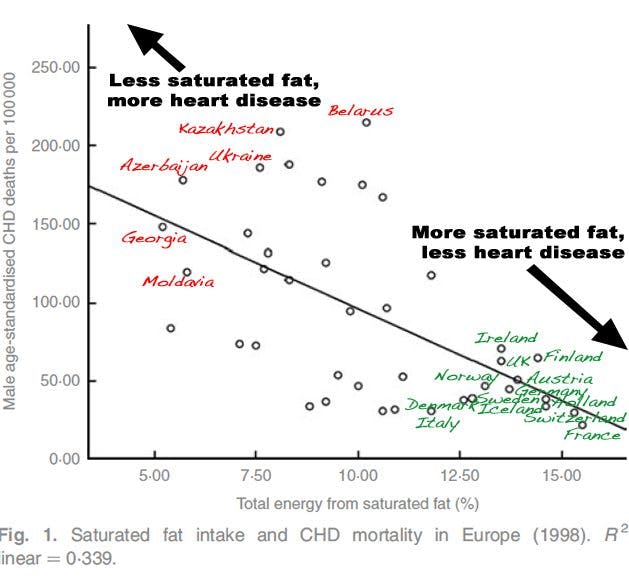
| Keys et al. [27] (1980) | Seven Countries Study | positive relation to risk of CHD and CHD mortality | average population intake of saturated fat was strongly related to 10- and 25-y population CHD mortality rates |
| Pietinen et al. [34] (1997) | ATBC Study | no association with coronary deaths | 0.93 (0.60–1.44, P = 0.91) |
| Kromhout et al. [20] (1984) | Zutphen Study | no association with coronary deaths | nonsignificant protective effect (P = 0.09) |
It is not clear why the IOM report included results from these six cohorts, although the results from at least 11 more cohorts were available, when published results until 2003 are considered. In addition to the six cohorts included in the meta-analysis by Siri-Tarino et al., I identified five other cohorts
[18],
[19],
[21],
[22],
[23].
The USDA/USDHHS report included only one article examining the direct relation between saturated fat and CVD. This was a pooled analysis of 11 cohort studies mentioned earlier
[26].
Results from this analysis were summarized as follows:
One meta-analysis examined effects of SFA reduction on incident coronary heart disease (CHD) outcomes by estimating the anticipated effects from statistical models where SFA is exchanged for equal energy from MUFA, PUFA, or carbohydrates (Jakobsen, 2009). These authors examined 11 American and European cohort studies and found a significant inverse association for PUFA (with 5% substitution for SFA) and coronary events (hazard ratio = 0.87, 95% CI, 0.77-0.97, and coronary death hazard ratio = 0.74, 95% CI, 0.61-0.89). They also found a positive association between substitution of MUFA or carbohydrates for SFA and risk of coronary events, but not risk of coronary deaths. To provide further context for the question of SFA replacement with other healthy fats or carbohydrates and CVD risk, a review by Hu et al. (2001) was helpful. Figure D3.1 shows the estimated changes in risk of coronary heart disease associated with isocaloric substitution of SFA (at 5% energy) with healthy fats such as MUFA or PUFA or carbohydrates, as well as substitution of trans fatty acids (at 2% energy). In all cases of isocaloric SFA or trans fatty acid substitution, there is a decrease in CHD risk. (p. D3–16)
In this text, Figure D3.1 refers to Figure 1 from a review article
[35]. As mentioned earlier, this figure describes the estimated changes in the risk of CHD associated with isocaloric dietary substitutions. What is not mentioned is the fact that these estimated changes are based on data from a single prospective study, the Nurses’ Health Study
[28]. However, the pooled analysis by Jakobsen et al.
[26] also includes data from the Nurses’ Health Study, with a slightly longer period of follow-up (16.5 versus 14 y), and Jakobsen et al. referred to the same article for the included data.
This means that pooled data from 11 cohort studies were “put into perspective” by estimated changes from one cohort included in these data. The researchers from this pooled analysis found that the substitution of MUFAs or carbohydrates for saturated fatty acids increased risk of coronary events. The USDA/USDHHS ignored these findings and found more evidence for the opposite effect, based on data from one cohort included in this pooled analysis, after a shorter follow-up period.
Further on in the text, the USDA/USDHHS describes the findings by Jakobsen et al. as follows:
A pooled analysis of 11 prospective cohort studies showed that risk of coronary events and coronary death was lowest with 5 percent energy substitution of SFA with PUFA > MUFA > carbohydrate (Jakobsen, 2009). (p. D3–24)
This type of wording suggests that the pooled analysis found a decreased risk of replacing saturated fat by monounsaturated fat or carbohydrates, although actually the opposite was true, as mentioned earlier.
It is unclear why the USDA/USDHHS included this pooled analysis of 11 prospective studies, although results from at least 17 more prospective studies were available, when results until 2008 are considered. In addition to 10 cohorts included in the meta-analysis by Siri-Tarino et al., I identified seven other cohorts
[18],
[20],
[21],
[22],
[23],
[24],
[25].
The EFSA report described the effect from one prospective cohort study
[36] providing information about the relation between saturated fat intake and stroke:
In the Health Professional follow up study, no relationships between total fat intake or intake of SFA, cis-MUFA, and n-6 PUFA with risk of stroke have been reported (He et al., 2003). (p. 46)
It is unclear why the EFSA mentioned this one article.
Summary
Reports from all three advisory committees mentioned that saturated fat intake increases LDL cholesterol and included the effect of LDL cholesterol on CVD in the evidence for an association between saturated fat and CVD. Reports from two of the three advisory committees (IOM and EFSA) mentioned that saturated fat intake increases HDL cholesterol, but none of the reports considered the effect of HDL cholesterol on CVD in the evidence for an association between saturated fat and CVD, although a meta-analysis of 61 prospective studies found the ratio of total to HDL cholesterol to be the strongest predictor of ischemic heart disease mortality. Only the EFSA report included effects from a meta-analysis of 60 controlled trials. The IOM report chose to include an older version of this meta-analysis. The USDA/USDHHS report chose not to include results from the vast majority of available trials.
Only the EFSA report included data from randomized trials about the substitution of dietary fats in the evidence for an association. The evidence was based on a review of four randomly selected intervention trials, although evidence from a systematic review of 14 randomized trials was available. Results from this systematic review showed that the effect from the substitution of dietary fats could be attributed to monounsaturated fat intake, instead of saturated fat intake.
None of the reports from the advisory committees systematically evaluated results from prospective studies examining the direct relation between saturated fat intake and CVD. All three reports excluded results from the majority of studies available. None of the reports included any of the articles included in one of the other reports. Instead, all committees included their own randomly selected data on this subject. Moreover, the two U.S. reports misrepresented their results. The IOM report stated that most epidemiologic studies found a positive association between saturated fat intake and CHD, although significantly increased risks were found in only two of nine articles included in the results. The USDA/USDHHS report ignored the effects found by their own results and suggested that replacing saturated fats by carbohydrates or monounsaturated fats decreases the CHD risk.
Based on their results, none of the investigators from the systematic reviews included in this article concluded that changes in saturated fat intake would change the risk of CVD, regardless of the study design and the endpoint.
Conclusion
The results and conclusions about saturated fat intake in relation to CVD, from leading advisory committees, do not reflect the available scientific literature.
Discussion
The EFSA report was the only one to include data from randomized trials about the substitution of dietary fats in the results. Three meta-analyses of randomized trials were published from 2009 through 2010
[15],
[37],
[38] at approximately the same time as the EFSA report was published. Two analyses, including data from seven
[37] and eight
[15] trials, found (non)significant protective effects of substituting polyunsaturated fat for saturated fat against CHD risk and CHD mortality, but both analyses included results from a non-randomized trial
[14],
[39].
In the most recent meta-analysis, Ramsden et al.
[38] included seven trials. The researchers also found a significant protective effect against CHD risk but no significant association with CHD mortality
[38]. They mentioned that the study non-hydrogenated oils were substituted for
trans fatty acid–containing fats for subjects in the intervention group in each of the trials included in all three meta-analyses. Several other possible confounders have been identified. For example, in the STARS Study, the intervention group was advised to consume more fruits and vegetables
[40]. In the Oslo Diet–Heart Study, the intervention group was advised to consume more vegetables, fruits, nuts, and whole grains
[41]. In the LA Veterans Study, the control group was distinctly deficient in vitamin E
[12]. All these variables have been linked to CHD
[16]. This shows that none of these trials simply evaluated the effects of replacing saturated fat by polyunsaturated fat, making it impossible to isolate the effects from saturated fats on CHD. None of the investigators cited in the three meta-analyses concluded that changes in saturated fat intake would change the risk of CVD.
This leaves two types of studies to examine a possible effect from saturated fat on CVD: prospective cohort studies with CVD as the endpoint and controlled feeding trials with cholesterol as the endpoint. We should ask ourselves if we want to represent results from these types of studies to the general public as described in this review.
References
- Mensink RP, Zock PL, Kester AD, Katan MB. Effects of dietary fatty acids and carbohydrates on the ratio of serum total to HDL cholesterol and on serum lipids and apolipoproteins: a meta-analysis of 60 controlled trials. Am J Clin Nutr. 2003;77:1146–1155
- Prospective Studies Collaboration. Blood cholesterol and vascular mortality by age, sex, and blood pressure: a meta-analysis of individual data from 61 prospective studies with 55,000 vascular deaths. Lancet. 2007;370:1829–1839
- USDA and UDHHS. Report of the Dietary Guidelines Advisory Committee on the dietary guidelines for Americans, 2010. June 15, 2010. Available at: http://www.cnpp.usda.gov/DGAs2010-DGACReport.htm. Accessed February 13, 2011.
- Hite AH, Feinman RD, Guzman GE, Satin M, Schoenfeld PA, Wood RJ. In the face of contradictory evidence: report of the Dietary Guidelines for Americans Committee. Nutrition. 2010;26:915–924
- Institute of Medicine. Dietary fats: total fat and fatty acids. In: Dietary reference intakes for energy, carbohydrate, fiber, fat, fatty acids, cholesterol, protein, and amino acids (macronutrients); 2005. Available at: http://books.nap.edu/openbook.php?record_id=10490&page=422. Accessed February 14, 2011.
- EFSA Panel on Dietetic Products, Nutrition, and Allergies (NDA). Scientific opinion on dietary reference values for fats, including saturated fatty acids, polyunsaturated fatty acids, monounsaturated fatty acids, trans fatty acids, and cholesterol. EFSA J. 2010;8:1461; http://www.efsa.europa.eu/en/efsajournal/doc/1461.pdf
- Mensink RP, Katan MB. Effect of dietary fatty acids on serum lipids and lipoproteins. A meta-analysis of 27 trials. Arterioscler Thromb. 1992;12:911–919
- Berglund L, Lefevre M, Ginsberg HN, Kris-Etherton PM, Elmer PJ, Stewart PW, et al. Comparison of monounsaturated fat with carbohydrates as a replacement for saturated fat in subjects with a high metabolic risk profile: studies in the fasting and postprandial states. Am J Clin Nutr. 2007;86:1611–1620
- Hooper L, Summerbell CD, Higgins JPT, Thompson RL, Capps NE, Smith GD, et al. Dietary fat intake and prevention of cardiovascular disease: systematic review. BMJ. 2001;322:757–763
- Leren P. The Oslo Diet–Heart Study. Eleven-year report. Circulation. 1970;42:935–942
- Sacks FM, Katan M. Randomized clinical trials on the effects of dietary fat and carbohydrate on plasma lipoproteins and cardiovascular disease. Am J Med. 2002;113(suppl 9B):13S–24S
- Dayton S, Pearce ML, Hashimoto S, Dixon WJ, Tomiyasu U. A controlled clinical trial of a diet high in unsaturated fat in preventing complications of atherosclerosis. Circulation. 1969;40(suppl 2):1–63
- Research Committee. Controlled trial of soya-bean oil in myocardial infarction. Lancet. 1968;2:693–699
- Turpeinen O, Karvonen MJ, Pekkarinen M, Miettinen M, Elosuo R, Paavilainen E. Dietary prevention of coronary heart disease: the Finnish Mental Hospital Study. Int J Epidemiol. 1979;8:99–118
- Skeaff CM, Miller J. Dietary fat and coronary heart disease: summary of evidence from prospective cohort and randomised controlled trials. Ann Nutr Metab. 2009;55:173–201
- Mente A. A systematic review of the evidence supporting a causal link between dietary factors and coronary heart disease. Arch Intern Med. 2009;169:659–669
- Siri-Tarino PW, Sun Q, Hu FB, Krauss RM. Meta-analysis of prospective cohort studies evaluating the association of saturated fat with cardiovascular disease. Am J Clin Nutr. 2010;91:535–546
- Gordon T, Kagan A, Garcia-Palmieri M, Kannel WB, Zukel WJ, Tillotson J. Diet and its relation to coronary heart disease and death in three populations. Circulation. 1981;63:500–515
- Knekt P, Reunanen A, Järvinen R, Seppänen R, Heliövaara M, Aromaa A. Antioxidant vitamin intake and coronary mortality in a longitudinal population study. Am J Epidemiol. 1994;139:1180–1189
- Kromhout D, de Lezenne Coulander C. Diet, prevalence and 10-year mortality from coronary heart disease in 871 middle-aged men. The Zutphen Study. Am J Epidemiol. 1984;119:733–741
- Kromhout D, Feskens EJ, Bowles CH. The protective effect of a small amount of fish on coronary heart disease mortality in an elderly population. Int J Epidemiol. 1995;24:340–345
- Soinio M, Laakso M, Lehto S, Hakala P, Rönnemaa T. Dietary fat predicts coronary heart disease events in subjects with type 2 diabetes. Diabetes Care. 2003;26:619–624
- Erkkilä AT, Lehto S, Pyörälä K, Uusitupa MI. n-3 Fatty acids and 5-y risks of death and cardiovascular disease events in patients with coronary artery disease. Am J Clin Nutr. 2003;78:65–71
- Ness AR, Maynard M, Frankel S, Smith GD, Frobisher C, Leary SD. Diet in childhood and adult cardiovascular and all cause mortality: the Boyd Orr cohort. Heart. 2005;91:894–898
- Umesawa M, Iso H, Ishihara J, Saito I, Kokubo Y, Inoue M. Dietary calcium intake and risks of stroke, its subtypes, and coronary heart disease in Japanese: the JPHC Study Cohort I. Stroke. 2008;39:2449–2456
- Jakobsen MU, O’Reilly EJ, Heitmann BL, Pereira MA, Bälter K, Fraser GE, et al. Major types of dietary fat and risk of coronary heart disease: a pooled analysis of 11 cohort studies. Am J Clin Nutr. 2009;89:1425–1432
- Keys A, Aravanis C, Blackburn H, Buzina R, Djordević BS, Dontas AS, et al. Seven countries. A multivariate analysis of death and coronary heart disease. Cambridge, MA: Harvard University Press; 1980;
- Hu FB, Stampfer MJ, Manson JE, Rimm E, Colditz GA, Rosner BA. Dietary fat intake and the risk of coronary heart disease in women. N Engl J Med. 1997;337:1491–1499
- Hu FB, Stampfer MJ, Manson JE, Ascherio A, Colditz GA, Speizer FE. Dietary saturated fats and their food sources in relation to the risk of coronary heart disease in women. Am J Clin Nutr. 1999;70:1001–1008
- Hu FB, Stampfer MJ, Rimm E, Ascherio A, Rosner BA, Spiegelman D. Dietary fat and coronary heart disease: a comparison of approaches for adjusting for total energy intake and modeling repeated dietary measurements. Am J Epidemiol. 1999;149:531–540
- McGee DL, Reed DM, Yano K, Kagan A, Tillotson J. Ten-year incidence of coronary heart disease in the Honolulu Heart Program. Relationship to nutrient intake. Am J Epidemiol. 1984;119:667–676
- Ascherio A, Rimm EB, Giovannucci EL, Spiegelman D, Stampfer M, Willett WC. Dietary fat and risk of coronary heart disease in men: cohort follow up study in the United States. BMJ. 1996;313:84–90
- Goldbourt U, Yaari S, Medalie JH. Factors predictive of long-term coronary heart disease mortality among 10,059 male Israeli civil servants and municipal employees. A 23-year mortality follow-up in the Israeli Ischemic Heart Disease Study. Cardiology. 1993;82:100–121
- Pietinen P, Ascherio A, Korhonen P, Hartman AM, Willett WC, Albanes D. Intake of fatty acids and risk of coronary heart disease in a cohort of Finnish men. The Alpha-Tocopherol, Beta-Carotene Cancer Prevention Study. Am J Epidemiol. 1997;145:876–887
- Hu FB, Manson JE, Willett WC. Types of dietary fat and risk of coronary heart disease: a critical review. J Am Coll Nutr. 2001;20:5–19
- He K, Merchant A, Rimm EB, Rosner BA, Stampfer MJ, Willet WC. Dietary fat intake and risk of stroke in male US healthcare professionals: 14 year prospective cohort study. BMJ. 2003;327:777–782
- Mozaffarian D, Micha R, Wallace S. Effects on coronary heart disease of increasing polyunsaturated fat in place of saturated fat: a systematic review and meta-analysis of randomized controlled trials. PLoS Med. 2010;7:e1000252
- Ramsden CE, Hibbeln JR, Majchrzak SF, Davis JM. N-6 fatty acid-specific and mixed polyunsaturated dietary interventions have different effects on CHD risk: a meta-analysis of randomised controlled trials. Br J Nutr. 2010;104:1586–1600
- Miettinen M, Turpeinen O, Karvonen MJ, Pekkarinen M, Paavilainen E, et al. Dietary prevention of coronary heart disease in women: the Finnish mental hospital study. Int J Epidemiol. 1983;12:17–25
- Watts GF, Jackson P, Burke V, Lewis B. Dietary fatty acids and progression of coronary artery disease in men. Am J Clin Nutr. 1996;64:202–209
- Leren P. The effect of plasma cholesterol lowering diet in male survivors of myocardial infarction. A controlled clinical trial. Acta Med Scand Suppl. 1966;466:1–92


 Statins have been almost universally hailed as “wonder drugs” by medical authorities around the world. The market for statins was $26 billion in 2005, and sales for Lipitor alone reached $14 billion in 2006. Merck and Bristol Myers-Squib are actively seeking “over-the-counter” (OTC) status for their statin drugs. Statins are prescribed to men and women, children and the elderly, people with heart disease and people without heart disease.