FB-TW

Showing posts with label AstraZeneca. Show all posts

Wednesday, February 12, 2014

Should Everyone Be Taking Cholesterol-Lowering Drugs? - Eenfeldt

Should Everyone Be Taking Cholesterol-Lowering Drugs?

Andreas Eenfeldt, MD.
 
A new review of previous research shows that even people with no history of heart disease may slightly lower their risk for heart disease with preventative statin medication*.

Independent.co.uk: ‘Millions’ more to be prescribed statins to beat high cholesterol
There are three reasons to be skeptical of mass medication of the healthy population:

1

All studies included in the review were sponsored by pharmaceutical companies, that sell the drugs involved. It’s not controversial that this leads to positive effects being exaggerated and negative side effects being silenced.

When big money like this is at stake, pharmaceutical companies will use every trick in the book. One of the more obvious examples was when the gigantic JUPITER trial was prematurely terminated by AstraZeneca, just when the figures for their drug happened to look good.

2

These are not harmless vitamin pills we’re talking about. Statins come with relatively frequent side effects, such as muscle pain, muscle weakness, fatigue, a slightly reduced cognitive functioning (on average) and an increased risk of diabetes.

3

The reduction in risk of heart disease in previously heart healthy individuals is hardly great. According to this review the chance of preventing a heart attack, or a similar event, by taking a drug for five years is 1.8 percent! Thus, there is a 98.2 percent likelihood that taking the drug for five years doesn’t protect against such health problems. The risk of troublesome side effects? Significantly greater than the chance of any benefit.

Note that a 1.8 precent chance of benefitting from five years of medication only applies if we blindly trust the pharmaceutical companies’ own studies. Most likely the results are exaggerated, so the chance of a benefit would likely be significantly less than 1.8 percent.

1+2+3+=

Most people probably wouldn’t accept the risk of side effects and long-term medication if told about the 98 percent (at least) risk of having done so in vain.

Would you?
===================================================================
Read the complete article here.

Monday, August 5, 2013

Who shall guard the guardians? - Dr. Malcolm Kendrick


Mainstream medicine increasingly relies on Guidelines. Well, they are called guidelines, but increasingly they carry the force of law. In many countries if you try to practice outside the wise and infallible guidelines you may lose your license to practice medicine. In the US, you may well be dragged into court, and if you have not been following the guidelines, you will be sued. You can even be gaoled (or jailed, as we say in the UK).

In short, guidelines are very serious and important things indeed, and they now rule medicine with a rod of steel. In the UK up to 50% of general practice time is spend ensuring that all patients are constantly monitored to ensure that various guidelines are rigorously followed. Is the BP low enough, the cholesterol low enough, have you checked blood sugar levels etc.

But where do guidelines come from – exactly? Who gives people the right to sit on guideline committees? What are the entrance requirements? Who shall guard the guideliners?

The answer is, perhaps shockingly, that there are almost no rules to this. If a group, such as the National Institutes for Health in the US, decides to set up a committee to decide on, for example, what is the healthy level for cholesterol lowering, what happens? They ask a number of Key Opinion Leaders to join the committee. In this case the NCEP (National Cholesterol Education Programme – which is a committee, not a programme).

In 2004 this committee decided that cholesterol levels should be lowered far more aggressively than in the past. Based on, as far as I could see, very flimsy evidence.  Could it be that that committee was, in some way, biased in favour of cholesterol lowering companies?  A number of people, including me, demanded to see if any of the eight invited members of this hugely important committee had financial conflicts.

With much reluctance, the conflicts were revealed (I have highlighted, in bold, the companies who marketed cholesterol lowering agents at the time.) See below

ATP III Update 2004:  Financial Disclosure of NCEP members
Dr. Cleeman: (Chairman) has no financial relationships to disclose.
Dr. Grundy: has received honoraria from Merck, Pfizer, Sankyo, Bayer, Merck/Schering-Plough, Kos, Abbott, Bristol-Myers Squibb, and AstraZeneca; he has received research grants from Merck, Abbott, and Glaxo Smith Kline.
Dr. Bairey Merz: has received lecture honoraria from Pfizer, Merck, and Kos; she has served as a consultant for Pfizer, Bayer, and EHC (Merck); she has received unrestricted institutional grants for Continuing Medical Education from Pfizer, Procter & Gamble, Novartis, Wyeth, AstraZeneca, and Bristol-Myers Squibb Medical Imaging; she has received a research grant from Merck; she has stock in Boston Scientific, IVAX, Eli Lilly, Medtronic, Johnson & Johnson, SCIPIE Insurance, ATS Medical, and Biosite.
Dr. Brewer: has received honoraria from AstraZeneca, Pfizer, Lipid Sciences, Merck, Merck/Schering-Plough, Fournier, Tularik, Esperion, and Novartis; he has served as a consultant for AstraZeneca, Pfizer, Lipid Sciences, Merck, Merck/Schering-Plough, Fournier, Tularik, Sankyo, and Novartis.
Dr. Clark: has received honoraria for educational presentations from Abbott, AstraZeneca, Bristol-Myers Squibb, Merck, and Pfizer; he has received grant/research support from Abbott, AstraZeneca, Bristol-Myers Squibb, Merck, and Pfizer.
Dr. Hunninghake: has received honoraria for consulting and speakers bureau from AstraZeneca, Merck, Merck/Schering-Plough, and Pfizer, and for consulting from Kos; he has received research grants from AstraZeneca, Bristol-Myers Squibb, Kos, Merck, Merck/Schering-Plough, Novartis, and Pfizer.
Dr. Pasternak: has served as a speaker for Pfizer, Merck, Merck/Schering-Plough, Takeda, Kos, BMS-Sanofi, and Novartis; he has served as a consultant for Merck, Merck/Schering-Plough, Sanofi, Pfizer Health Solutions, Johnson & Johnson-Merck, and AstraZeneca.
Dr. Smith: has received institutional research support from Merck; he has stock in Medtronic and Johnson & Johnson.
Dr. Stone: has received honoraria for educational lectures from Abbott, AstraZeneca, Bristol-Myers Squibb, Kos, Merck, Merck/Schering-Plough, Novartis, Pfizer, Reliant, and Sankyo; he has served as a consultant for Abbott, Merck, Merck/Schering-Plough, Pfizer, and Reliant.

http://www.nhlbi.nih.gov/guidelines/cholesterol/atp3upd04_disclose.htm

Of course, as people have stated to me, the mere fact that there were seventy two financial conflicts of interest does not mean that the guidelines themselves were biased. But you know what, I don’t believe it. Imagine if eight Supreme Court judges, ruling on any issue, had seventy two direct financial conflicts of interest to do with that issue…..Well, the outcry would never end.

Yet doctors, it seems, are beyond any suspicion – of any sort. There is not the slightest possibility that any doctor would ever do anything wrong….We are, after all, superior beings. ‘But, what’s that you say skippy…. hold on.’

‘Despite a 2-year-old scandal discrediting key evidence, current guidelines relying on this evidence have not been revised. As a result of physicians following these guidelines, some researchers say, it is possible that thousands of patients may have died each year in the UK alone. It is unlikely that a true understanding of the damage will ever be known…..

The guidelines, which were published in 2009, were based on analyses of the available trials. The strongest evidence came from the DECREASE family of trials, which appeared to strongly support perioperative beta-blockade, and one other large trial, POISE, which raised concerns that beta-blockers might lead to an increase in deaths

In 2011, however, faith in the reliability of the DECREASE trials was shattered as a result of a scientific misconduct scandal centering on the principal investigator of the studies, the now disgraced Dutch researcher Don Poldermans. The issue was further complicated because, in addition to his key role in the trials, Poldermans was the chairman of the committee that drafted the guidelines.

’ http://cardiobrief.org/2013/07/31/european-heart-guidelines-based-on-disgraced-research-may-have-caused-thousands-of-deaths/

Oh well, maybe not.

The fact is that, wherever you look, guidelines are being developed by doctors who have widespread conflicts of interest. And if you go a step further back to review the studies that the guidelines are based on, they are run by, and written up by, doctors who have enormous conflicts of interest. Although sometimes, these conflicts are just…well, forgotten about.

For example, a few opinion leader were ‘named and shamed’ by the Journal of the American Medical Association, when someone pointed out that a number of the authors of the original paper they wrote might just have slipped up in declaring their conflicts:

Unreported Financial Disclosures in: ‘Association of LDL Cholesterol, Non–HDL Cholesterol, and Apolipoprotein B Levels With Risk of Cardiovascular Events Among Patients Treated With Statins: A Meta-analysis.’
 
….the following disclosures should have been reported:
 
 “Dr Mora reports receipt of travel accommodations/meeting expenses from Pfizer; Dr Durrington reports provision of consulting services to Hoffman-La Roche, delivering lectures or serving on the speakers bureau for Pfizer, and receipt of royalties from Hodder Arnold Health Press; Dr Hitman reports receipt of lecture fees and travel expenses from Pfizer, provision of consulting services on advisory panels to GlaxoSmithKline, Merck Sharp & Dohme, Eli Lilly, and Novo Nordisk, receipt of a grant from Eli Lilly, and delivering lectures or serving on the speakers bureau for GlaxoSmithKline, Takeda, and Merck Sharp & Dohme; Dr Welch reports receipt of a grant, consulting fees, travel support, payment for writing or manuscript review, and provision of writing assistance, medicines, equipment, or administrative support from Pfizer, and provision of consultancy services to Edwards, MAP, and NuPathe; Dr Demicco reports having stock/stock options with Pfizer; Dr Clearfield reports provision of consulting services on advisory committees to Merck Sharp & Dohme and AstraZeneca; Dr Tonkin reports provision of consulting services to Pfizer, delivering lectures or serving on the speakers bureau for Novartis and Roche, and having stock/stock options with CSL and Sonic Health Care; and Dr Ridker reports board membership with Merck Sharp & Dohme and receipt of a grant or pending grant to his institution from Amgen.
 
 
Not a bad little list.

As you can see, Dr Ridker had board membership with Merck Sharp and Dohme…… a company that has made billions from selling statins. Now, here is he is authoring a paper on the benefit of statins (which will be used to develop guidelines on cholesterol lowering), and he simply forgot about this conflict of interest. As for the others, well, they’re also busy people; things must have just slipped their minds, such as thirty three separate financial conflicts.

For this terrible crime against the integrity of medical science, none of them can ever again do medical research, or author a medical paper, or sit on guideline committees. Cue, mad cackling laughter. As you may expect, absolutely nothing happened at all, apart from the publication of that statement you in the Journal in the American Medical Journal (JAMA).

I am sorry, but the system of developing guidelines is, frankly, bust. It has been for many years, but it is a very big and dangerous looking nettle to grasp, and no-one, currently has the will to do it.

Someone, somewhere, needs to ensure that guidelines, and the evidence they are based on, and the interpretation of that evidence, is of the highest quality – and free from potential bias, and financial conflicts of interest. We are about as far from this happy state of affairs as I am from being invited onto any guideline committee, ever, anywhere.

And that, my friend, is a very, very long way away indeed. You would need to Hubble telescope to see across distances as vast as that.
 

Friday, December 21, 2012

Real Life vs. Pharma Company Studies - Kendrick

Real Life vs. Pharma Company Studies

December 21, 2012

At what point, exactly, does credibility snap? When does the difference between what we are told, and what we observe, reach such a state of dissonance that it is no longer possible to believe both. Sometimes it seems the answer is ….never.

Here is one example. The clinical trials on statins found that they have virtually no adverse effects. Or, to be a little more accurate, that adverse events were virtually identical to placebo. Here, for example, is part of the press release from the Heart Protection Study (HPS). This was the last major placebo controlled statin study done in people with already diagnosed cardiovascular disease.

As the benefits of statins are now thought so wonderful it would be considered unethical to do a placebo controlled study anymore. You would be withholding statins from people who need them. Which means that you are not going to get any more evidence in this area – ever again. The HPS results were published around ten years ago, and the press release contained the following

‘Although muscle pain was reported by the participants, this happened about as commonly among those allocated the active simvastatin as among those allocated the placebo tablets. Despite 20,536 randomised patients having been followed for an average of five years, blood tests among people reporting muscle symptoms found only 11 simvastatin-allocated patients and 6 placebo-allocated patients with a rise in the muscle enzyme creatine kinase (CK) to more than 10 times the upper limit of normal Of these, 14 met the definition for “myopathy” (i.e. muscle symptoms associated with such CK elevations) of whom 10 were in the simvastatin group and 4 in the placebo group.’

http://www.ctsu.ox.ac.uk/~hps/June02QandA.shtml

Teasing these figures out a little more it seems that an extra six people taking simvastatin suffered muscle ‘problems’ than those taking the placebo. This is six people, out of more than ten thousand taking simvastatin. This represents in one thousand seven hundred and eight 1/1708 (over five years).
If this were true, then muscle problems should be exceedingly rare. The average GP with about two hundred of their fifteen hundred patients taking a statin should see a patient with muscle pains/problems about once every twenty five years. At this rate, you would not even know you had a problem.

Yet, wrapped around my copy of the BMJ last week was an advert for rosuvastatin [Crestor]. The strap line shouted out ‘Myalgia on his initial statin?’ [Myalgia is the medical word for muscle pain]. The main message the advert was… ‘If your patient was suffering muscle pains on their initial statin, they should switch to Crestor 5mg.’

Their ‘initial statin’ will almost certainly be Simvastatin 40mg. The drug, and the dose, used in the HPS study. The same drug, and the same dose recommended by the National Institute of Clinical Excellence (NICE).

Now, you do not run an expensive advertising campaign without doing a lot of market research first. What the market research must have told AstraZeneca – who make Crestor – is that a lot of people are suffering muscle pains on 40mg simvastatin.

Which means that simvastatin, which caused no discernible increase in muscle pains in the clinical study…… actually creates such a massive burden of muscle problems that a pharmaceutical campaign is running a major advertising campaign highlighting this, exact, adverse event.

What does this tell us, gentle reader? It tells us many things. Some of which would be considerable slanderous if I said them out loud. The most outstanding thing it tells me is that, although we have all been repeatedly informed that statins have no more side-effects than placebo, I now find that AstraZeneca encouraging doctors to switch statins due to the burden of side-effects.

F Scott Fitzgerald opined that …“The test of a first-rate intelligence is the ability to hold two opposed ideas in the mind at the same time, and still retain the ability to function.’

I would suggest that there comes a point where you have to decide between which idea is right, and which is wrong. With regard to statins, I did this many years ago when I recognised that they cause a gigantic burden of adverse effects, with muscle pain the single most outstanding. I knew that the clinical trials had somehow or another managed to bury this fact.

Yet, when I speak to most doctors they continue to tell me that statins have very few side-effects, as do most opinion leaders. This belief, whilst AstraZeneca starts up an advertising campaign based on side-effects reported by doctors. F Scott Fitzgerland would be impressed by all these first class intellects. I just despair of them.
============================================================
Read the complete article here.

Monday, October 15, 2012

Confirmed Again: Statin Drugs Accelerate Cardiovascular Disease - Mercola

Confirmed Again: Statin Drugs Accelerate Cardiovascular Disease
October 15 2012

By Dr. Mercola
Statins are the world's most-prescribed class of medications. A staggering one in four Americans over the age of 45 now take cholesterol-lowering drugs such as Pravachol, Mevacor, Lipitor, Zocor, Crestor, and others. A majority of them are taking these drugs for primary prevention of heart attacks and strokes.

However, mounting research suggests this could be a critical mistake.

Most recently, two separate studies have concluded that progression of coronary artery calcification, which is the hallmark of potentially lethal heart disease, is INCREASED with statin drug use.

Statins Increase Prevalence of Coronary Calcification by More than 50 Percent!

A new study in the journal Atherosclerosis1 shows that statin use is associated with a 52 percent increased prevalence and extent of calcified coronary plaque compared to non-users. None of the participants in the study – 6,673 in all – had any known coronary artery disease at the time of undergoing coronary CT angiography (CCTA) – a non-invasive method that allows you to see coronary atherosclerotic features, including plaque composition.

Arterial plaque is a hallmark of cardiovascular disease and increases your risk of all-cause mortality, so clearly, anything that increases calcification and stiffening of your arteries is wisely avoided. And statins seem to fall into this category.

These disturbing findings come right on the heels of another study published in the journal Diabetes Care,2 which discovered that type 2 diabetics with advanced atherosclerosis who are frequent statin users have significantly higher amounts of coronary artery calcification compared to less frequent users of the drug.

Furthermore, in a subgroup of participants who initially were not receiving statins, progression of both coronary artery calcification as well as abdominal aortic artery calcification was significantly increased when they began frequent statin use.
The authors concluded that:
"More frequent statin use is associated with accelerated coronary artery calcification in T2DM patients with advanced atherosclerosis."
So much for statins being the answer for diabetics... Diabetes is a risk factor for cardiovascular disease, which is why many diabetics are prescribed a statin drug to reduce their risk. Alas, as these studies show, statins actually accelerate the progression of disease!

Making matters worse, statins have also been shown to significantly increase your risk of developing type 2 diabetes3 if you don't have it already. This is a risk everyone needs to be aware of. In one study, statins increased the risk of type 2 diabetics in postmenopausal women by 48 percent.4

Few People Really Benefit from a Statin Drug

Statins, I believe, are one of the most unnecessary drugs on the market. A small group of people with familial hypercholesterolemia, a genetic defect that causes cholesterol levels above 325-350, do seem to benefit from statins. However, in my clinical experience over more than two decades and tens of thousands of patients, I had a grand total of three patients that fell into this category as it's a relatively uncommon genetic problem.
The fact that one in four Americans over the age of 45 is now taking a statin drug as a form of "preventive medicine" does not bode well when you consider the massive increases in disease risk these drugs are now associated with. It's downright shocking that doctors are so slow to realize the potential damage inflicted on their patients for no reward at all.

The research that led to statins being heavily promoted as a form of primary prevention of heart disease and stroke was funded by AstraZeneca, the maker of Crestor. Since the release of that study in 2008, none of their claims have turned out to hold water in subsequent research. On the contrary, as the two featured studies show, they actually worsen cardiovascular disease progression.

The drugs also come with an avalanche of other potential side effects, which tend to be dose dependent.5 In fact, as of 2009 there were well over 900 studies proving their adverse effects, which run the gamut from muscle problems to increased cancer risk. One of the primary mechanisms of harm appears to be CoQ10 depletion. If you take statin drugs without supplementing with CoQ10 (or ideally, the reduced form, called ubiquinol, which is far more effective), your health is at serious risk.

GreenMedInfo.com has compiled over 300 documented adverse health effects associated with statins,6 some of the most common of which include:
Muscle problems, polyneuropathy (nerve damage in the hands and feet), and rhabdomyolysis (a serious degenerative muscle tissue condition) Anemia
Acidosis Sexual dysfunction
Immune depression Cataracts
Pancreas or liver dysfunction, including a potential increase in liver enzymes Memory loss

What You Need to Know About Cholesterol in Order to Understand the Dangers of Statins

Statin drugs work by preventing the formation of cholesterol and reduce LDL cholesterol, which is considered the "bad" cholesterol. There is no argument that these drugs can effectively lower your cholesterol levels. However, what has NOT been proven is that they significantly lower your risk of dying from heart disease. In no way, shape or form do they treat the underlying cause of your problem. They are nothing more than a toxic band-aid.

So just what makes statins so dangerous, and why are they not the answer for managing your cholesterol levels?

First you need to understand the biological workings of cholesterol. In fact, there is no such thing as "good" or "bad" cholesterol. Both HDL and LDL cholesterol perform vital functions in your body, which is why it's actually dangerous to bring your LDL levels down too low.

HDL (high density lipoprotein) and LDL (low density lipoprotein) are actually proteins that transport the cholesterol to and from your tissues. Cholesterol in turn is a precursor to your steroid hormones, bile acids, cell membrane walls and vitamin D. For example, cholesterol is essential for you to make testosterone or estrogen, cortisol, DHEA or pregnenolone, or a multitude of other steroid hormones that are necessary for health, without cholesterol. Even more importantly, your cells cannot regenerate their membranes without it.

The reason you have LDL to begin with is to transport the cholesterol to the tissues in order to make new cells and repair damaged ones. However, there are different sizes of LDL particles and it's the LDL particle size that is relevant, and statins do not modulate the size of the particles. Unfortunately, most people still don't know about that part, and very rarely, if ever, get tested for particle size. The particles are sticky, so very small LDL's can easily get stuck in different areas, and the build-up eventually causes inflammation and damage.

The only way to make sure your LDL particles are large enough to not cause damage is through your diet. In fact, it's one of the major functions of insulin.

Conveniently enough, a healthy diet is also the answer for type 2 diabetes, so by focusing on what you eat, you're treating both your diabetes and your cholesterol levels, and reducing your associated risk of heart disease. If you eat properly, which is really the only known good way to regulate LDL particle size, then it does the right thing; it takes the cholesterol to your tissues, the HDL takes it back to your liver, and no plaque is formed.

The Critical Importance of CoQ10

Again, if you're on a statin drug, you MUST take at least 100-200 mg of ubiquinol or CoQ10 per day. Ubiquinol is also beneficial for those not taking statins. If you're not on a statin drug, the amount of CoQ10 or ubiquinol you might need depends on how sick you are. The sicker you are, the more you need. As a general guideline if you're not ill, taking 50-100 mg per day would probably be sufficient. If you're over the age of 70, double that dose, or up to 200 mg per day. This is because your natural CoQ10 levels begin to drop after the age of 40, and by the age of 70, levels begin to precipitously drop.
Ideally, you'll want to split the dose up to two or three times a day, rather than taking it all at once, as this will result in higher blood levels. Other dosing guidelines include:
Hypertension 200 mg/day World class athletes who need extra ATP turnover, 300-600 mg/dayHeart transplant or severe CHF, 300-600 mg/day in divided doses
Arrhythmia 200 mg/dayTypical athlete 100-300 mg/day Mitral valve prolapse, a combination of 400 mg magnesium and 100-200 mg of CoQ10

How to Help Lower Your Cholesterol Naturally

There's really virtually NO reason to take statins and suffer the consequences from these ill-conceived drugs. If you truly want to normalize your cholesterol levels, following these simple lifestyle changes can help get you there:
  • First, normalize your insulin levels by eliminating sugar (particularly fructose) and grains. A fasting insulin level is easy to draw and is very inexpensive. It should be below 3.
  • Take a high-quality animal-based omega-3 supplement, such as krill oil.
  • Eat a good portion of your food raw (ideally organic to avoid agricultural chemicals).
  • Eat healthy, preferably raw, fats, such as:

    Olive oil Coconut and coconut oil Organic raw dairy products Avocados
    Raw organic nuts Seeds Pastured eggs (raw, or lightly cooked with yolks intact) Organic, grass-fed meats
  • Regular exercise is another important tool. When you exercise you increase your circulation and the blood flow throughout your body. The components of your immune system are also better circulated, which means your immune system has a better chance of fighting an illness before it has the opportunity to spread.
  • If you are a man, or a woman who is in menopause, you should check your iron levels, as elevated levels of iron can cause major oxidative damage in the blood vessels, heart and other organs. Excess iron is also one of the major contributing factors of cancer risk.
  • Avoid smoking and drinking alcohol excessively.
=====================================================================
Read the complete article here.

Friday, August 17, 2012

Another industry funded statin study that smacks of bad science and bias - Briffa

Another industry funded statin study that smacks of bad science and bias

‘JUPITER’ is the name given to a study which tested the effectiveness of the statin drug rosuvastatin (Crestor). The effects of rosuvastatin were compared with placebo in a large group of individuals free from a history of cardiovascular disease (such as previous heart attack or stroke) [1]. Testing in this setting (what is known as ‘primary prevention’) generally yields less beneficial results than in individuals with known cardiovascular disease (‘secondary prevention’). Despite being deemed at relatively low risk, the individuals treated with rosuvastatin saw significant improvements in some outcomes (more on this later), and the study got a lot of positive media and medical attention as a result.

One slight fly in the ointment that emerged from this study was the fact that those treated with a statin had a significantly increased risk of developing type 2 diabetes. Other studies have also found statins can up the risk of this condition. So, last week a study was published [2] in the Lancet medical journal, in which the original JUPITER authors looked again at their data to, supposedly, assess whether or not the benefits of rosuvastatin outweighed any risk from diabetes.

The authors found that the enhance risk of diabetes was only seen in individuals with at least one major risk factor diabetes. They go on to tell us that in this group, treatment with statins led to 54 new cases of diabetes being diagnosed. However, all is well because the group treated with statins also had 134 fewer ‘vascular events’.

The term ‘vascular’ event, however, covers a multitude of ills, including unstable angina (heart pain that comes on in an unpredictable fashion), non-fatal heart attacks, non-fatal strokes, fatal heart attacks, fatal strokes, and ‘revascularisations’ (e.g. insertion of a stent or bypass surgery). An outcome that is made up of lots of different outcomes is sometimes referred to as a ‘composite endpoint’. There is at least some doubt about the appropriateness of using composite endpoints to judge the effectiveness of medical interventions.

To begin with, the wider the net is cast, the more likely benefit will be seen, and the more likely the benefits will be deemed to be ‘statistically significant’. Also, some of the outcomes that are of limited relevance clinically (e.g. unstable angina) can occur frequently. This can skew the statistics in favour of finding ‘significant’ results, even though the clinical significance is debatable. The risk of the most important outcomes (such as fatal heart attacks and overall risk of death) may be reduced only a small amount or not at all.

Some researchers have raised the idea that drug companies and researchers may ‘game’ (deliberately manipulate) the design of studies by using composite endpoints in a way which inflates the apparent benefits of a drug [3].

In this latest regarding the impact of rosuvastatin on diabetes risk seen in the JUPITER study, the authors seem keen to remind us of the benefits of statins using a composite endpoint. However, analysis of adverse effects are limited to one outcome (diabetes). This basic technique really does much to stack the odds in favour of ending up a favourable end result.

I have seen many, many statin studies which use composite end points for benefits. Never, though, have I seen one which uses composite endpoints for adverse effects. In addition to increasing diabetes risk, statins have the potential to precipitate a range of other adverse effects including muscle pain, muscle damage, liver damage and kidney damage. How about lumping all those and other effects together to see how that ‘benefits’ and ‘risks’ stack up then?

There’s more than a whiff of bias here. Is there any other evidence that the authors of the study were biased and committed, perhaps, to finding positive results for rosuvastatin? I believe so.

In the abstract (summary) of the study, the authors are keen to point out that in individuals statins reduced the risk of venous thromboembolism (e.g. clots in the veins of the legs known as deep vein thrombosis) by about half. They also tell us that in people with or without risk factors for diabetes statins reduced overall risk of death by 17 and 22 per cent respectively. These are impressive statistics perhaps. But what the authors neglect to tell us, though, is that none of these outcomes was ‘statistically significant’, which means the ‘benefits’ the authors laud were much more likely to be due to chance than any genuine effect from taking statins.

It’s unlikely that any of us will be too surprised to learn that the original JUPITER study and this latest poor excuse of a paper were funded by the company that makes rosuvastatin (AstraZeneca).

References:
1. Ridker PM, et al. JUPITER Study Group. Rosuvastatin to prevent vascular events in men and women with elevated C-reactive protein. N Engl J Med 2008;359(21):2195-2207
2. Ridker PM, et al. Cardiovascular benefits and diabetes risks of statin therapy in primary prevention: an analysis from the JUPITER trial. The Lancet 2012;380(9841):565-571
3. Kip KE, et al. The Problem With Composite End Points in Cardiovascular Studies – The Story of Major Adverse Cardiac Events and Percutaneous Coronary Intervention. J Am Coll Cardiol. 2008;51(7):701-707
==================================================================
Read the full article here.

Thursday, May 31, 2012

More statin shenanigans


mouth full of pills

If you read the papers or watch the news you’ve probably heard about the recently published JUPITER study, advertised with bold headlines such as “Cholesterol drug causes risk of heart attack to plummet” and “Cholesterol-fighting drug shows wider benefit”. If you’ve been following this blog (and perhaps even if you haven’t), you are by now aware that such claims cannot be taken at face value.

You might suspect, for example, that the study was sponsored by a drug company and authored by researchers with financial interests tied to those drug companies. You might wonder if these associations could possibly – just possibly – influence not only the results of the study, but how those results are reported. You might also find yourself questioning the objectivity of a study with the title “Justification for the Use of Statins in Prevention: an Intervention Trial Evaluating Rosuvastatin” (JUPITER).

If you’re asking yourself these questions, you are definitely on the right track. The study was indeed sponsored by a drug company, AstraZeneca. And each author of this study received money in the form of grants, consulting fees and honoraria from pharmaceutical companies – in some cases up to twelve different companies, including AstraZeneca, the study sponsor. Take a look at this list detailing the financial interests of the study authors (now required by the New England Journal of Medicine and other prominent publications):

Dr. Ridker reports receiving grant support from AstraZeneca, Novartis, Merck, Abbott, Roche, and Sanofi-Aventis; consulting fees or lecture fees or both from AstraZeneca, Novartis, Merck, Merck–Schering-Plough, Sanofi-Aventis, Isis, Dade Behring, and Vascular Biogenics; and is listed as a coinventor on patents held by Brigham and Women’s Hospital that relate to the use of inflammatory biomarkers in cardiovascular disease, including the use of high-sensitivity C-reactive protein in the evaluation of patients’ risk of cardiovascular disease. These patents have been licensed to Dade Behring and AstraZeneca. Dr. Fonseca reports receiving research grants, lecture fees, and consulting fees from AstraZeneca, Pfizer, Schering-Plough, Sanofi-Aventis, and Merck; and Dr. Genest, lecture fees from AstraZeneca, Schering-Plough, Merck–Schering-Plough, Pfizer, Novartis, and Sanofi-Aventis and consulting fees from AstraZeneca, Merck, Merck Frosst, Schering-Plough, Pfizer, Novartis, Resverlogix, and Sanofi-Aventis. Dr. Gotto reports receiving consulting fees from Dupont, Novartis, Aegerion, Arisaph, Kowa, Merck, Merck–Schering-Plough, Pfizer, Genentech, Martek, and Reliant; serving as an expert witness; and receiving publication royalties. Dr. Kastelein reports receiving grant support from AstraZeneca, Pfizer, Roche, Novartis, Merck, Merck–Schering-Plough, Isis, Genzyme, and Sanofi-Aventis; lecture fees from AstraZeneca, GlaxoSmithKline, Pfizer, Novartis, Merck–Schering-Plough, Roche, Isis, and Boehringer Ingelheim; and consulting fees from AstraZeneca, Abbott, Pfizer, Isis, Genzyme, Roche, Novartis, Merck, Merck–Schering-Plough, and Sanofi-Aventis. Dr. Koenig reports receiving grant support from AstraZeneca, Roche, Anthera, Dade Behring and GlaxoSmithKline; lecture fees from AstraZeneca, Pfizer, Novartis, GlaxoSmithKline, DiaDexus, Roche, and Boehringer Ingelheim; and consulting fees from GlaxoSmithKline, Medlogix, Anthera, and Roche. Dr. Libby reports receiving lecture fees from Pfizer and lecture or consulting fees from AstraZeneca, Bristol-Myers Squibb, GlaxoSmithKline, Merck, Pfizer, Sanofi-Aventis, VIA Pharmaceuticals, Interleukin Genetics, Kowa Research Institute, Novartis, and Merck–Schering-Plough. Dr. Lorenzatti reports receiving grant support, lecture fees, and consulting fees from AstraZeneca, Takeda, and Novartis; Dr. Nordestgaard, lecture fees from AstraZeneca, Sanofi-Aventis, Pfizer, Boehringer Ingelheim, and Merck and consulting fees from AstraZeneca and BG Medicine; Dr. Shepherd, lecture fees from AstraZeneca, Pfizer, and Merck and consulting fees from AstraZeneca, Merck, Roche, GlaxoSmithKline, Pfizer, Nicox, and Oxford Biosciences; and Dr. Glynn, grant support from AstraZeneca and Bristol-Myers Squibb. No other potential conflict of interest relevant to this article was reported.
 
Now, the fact that these researchers receive money from all of these drug companies doesn’t mean that they are dishonest or that their data are invalid. However, if you think these conflicts of interest do not influence the outcomes of clinical research, then I suggest you read an article I published a few months ago called When It Comes To Drug Claims, Skepticism Is Healthy.

Now that you’ve put on your “Healthy Skeptic” goggles, we can move on and more closely examine the study itself. There are several things you need to be aware of as we discuss it.

First, although the press articles claim that the study looked at statin use in healthy populations, the subjects were people who had normal cholesterol but high CRP levels. CRP, or C-Reactive Protein, is a measure of inflammation in the body. It is now widely accepted even in the mainstream medical community that inflammation is a major risk factor for heart disease. And because inflammation is a sign of an underlying disease process, these patients were not, in fact, “healthy” as claimed.

There is little doubt that statins reduce inflammation, which can help prevent atherosclerosis. It appears that the benefits of statins are mainly due to this characteristic, rather than to their cholesterol-lowering effects. So it’s no surprise that the statins reduced rates of heart disease and mortality in this population that had inflammation going into the study.

I should also mention, however, that the predictive value of CRP for heart disease is highly controversial. Though some studies show a correlation between high CRP levels and heart disease, many others do not. Many physicians feel that CRP is not a useful indicator in clinical practice.

The second thing you need to be aware of is the difference between relative and absolute risk reduction. Relative risk reduction (RRR) measures how much the risk is reduced in the experimental group compared to a control group. Absolute risk reduction (ARR) is just the absolute difference in outcome rates between the control and treatment groups.

To make this more clear, let’s consider an example. Say that 2000 people enter a study for a particular drug and 1000 of them are randomized to placebo. At the end of the study, one person in the drug group died versus two people in the placebo group. The relative risk reduction of the drug group would thus be 50% (0.002 – 0.001/0.002). That sounds really impressive! The headline for this study might read “New drug reduces chance of dying by 50%!”. While technically true, you can see how misleading this can be. Why? Because when most people read that headline, they will interpret it to mean that if they take that drug, their risk of dying will be reduced by 50%, which is not even close to being true.

The absolute risk reduction, on the other hand, is always a much more modest number. Using the same example above, the absolute risk reduction in the drug group would have been a paltry one-tenth of a percent, or 0.1% (0.002 – 0.001). That’s not a very catchy headline, is it? “New drug reduces risk of dying by one-tenth of a percent”. It just doesn’t grab you the same way. But this is actually a more realistic view of what happened in the study and what we could expect to happen in the real world.

In fact, one could just as accurately say that in this hypothetical study, a patient has a 1-in-1000 (0.1%) chance of their life being saved by the drug. Said another way, 1,000 patients would have to be treated with this drug in order to save a single life. This measurement is called the Needed Number to Treat, and is another means for interpreting the results of clinical trials.

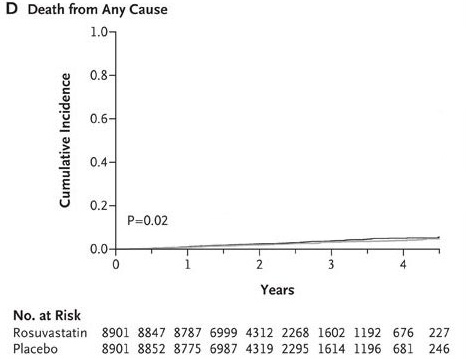
With that in mind, let’s examine the data from the JUPITER study. The actual numbers were 198 deaths out of 8901 in the statin group and 247 deaths out of 8901 in the placebo group. The relative risk reduction for total mortality (deaths) in the drug group was 19.8% [(247/8901 - 198/8901) / (247/8901)]. That means that the risk of death for people taking Crestor was 19.8% smaller than those taking placebo.

But what happens when we look at the absolute risk reduction numbers? According to the data, 2.77% (0.02774) of people taking the placebo died after two years versus 2.24% (0.02224) of people taking Crestor. This amounts to a difference of 0.55%, or one-half of one percent.

Here’s a graphical illustration of the difference in mortality between the Crestor and placebo group:
jupiter graph
If you’re having trouble making much of a difference, I don’t blame you!

To make this even more clear, let’s use the Needed Number to Treat method of evaluating these results. According to the study data, 182 people would have to be treated with Crestor for two years in order to save a single life.

Now that may not sound like a large number to you, especially if yours was one of the lives saved. However, when evaluating the viability of any potential treatment three considerations (above and beyond the efficacy of the treatment) must be taken into account: cost, side effects, and alternatives.

Let’s look at cost first. The cost of one patient taking Crestor for one year is approximately $1,300. Therefore, to prevent 49 deaths 8,901 people would have to take Crestor for two years at a cost of $23 million dollars. That is an enormously expensive treatment by any measure.

Second, this particular study did not register significant side effects in the statin group. This is very fishy, though, since nearly every other study on statins to date has shown significant side effects and the approval of Crestor itself was delayed by the FDA due to concern about Crestor side effects.

While all statins are associated with rare instances of rhabdomyolysis, a breakdown of muscle cells, Crestor had shown in studies before its approval that the potentially deadly disease had surfaced in seven people. Crestor’s potential muscle- and liver-damaging side effects become more worrisome and difficult to justify in patients who are essentially healthy.

What’s more, the study only lasted two years. That’s not long enough to adequately establish safety for the drug, especially if people are going to use it “preventatively”, which means they could be taking it for several years and even decades. Statins have caused cancer in every single animal study to date. Since cancer can take up to 25 years to develop after initial exposure to the carcinogen, we simply cannot know at this point that statins won’t also significantly increase the risk of cancer in adults.

Finally, before jumping on the statin bandwagon and recommending that we spend billions of dollars treating healthy people with Crestor, we should consider if there isn’t a less costly and risky way of preventing deaths due to inflammation and heart disease.

Wouldn’t you know it, there sure is!

For the last decade medical research has increasingly demonstrated that heart disease is caused not by high cholesterol levels, but by inflammation and oxidative damage. A full explanation of these mechanisms is beyond the scope of this post, but for more details you can read two previous articles: Cholesterol Doesn’t Cause Heart Disease and How To Increase Your Risk of Heart Disease.

So, if we want to prevent and even treat heart disease, we need to address the causes of inflammation and oxidative damage. Again, there’s not room to go into great detail on this here but in general the primary causes of inflammation and oxidative damage are 1) a diet high in polyunsaturated oil (PUFA) and refined flour and sugar, 2) lack of physical activity, 3) stress and 4) smoking.

We can thus prevent heart disease by avoiding PUFA and refined/processed food, getting adequate exercise, reducing stress and not smoking. These simple dietary and lifestyle changes are likely to produce even better results than a statin, for a fraction of the cost and without any side effects. In fact, the only side effects of this approach are improved physiological and psychological health! For more specific recommendations, read my article Preventing Heart Disease Without Drugs.

Taking a statin to “prevent” inflammation and heart disease is rather like bailing water with a pail to prevent a boat from sinking instead of simply plugging the leak. Unfortunately, our entire health care system is oriented around “bailing water with a pail”, which is to say treating the symptoms of disease, instead of “plugging the leak”, or addressing the causes of disease before it develops. The reason this is the case is because there’s a lot more money to be made from drugs, surgery and other costly interventions than there is from encouraging people to eat well, exercise and reduce stress.

Even if we ignore all of the issues I’ve pointed out above, the best thing we can say about this study is that a small group of unusual patients – those with low LDL-cholesterol AND high C-reactive protein – may slightly decrease their risk for all-cause mortality by taking a drug that costs them almost $1,300 per year and slightly increases their risk for developing diabetes.

That’s the best spin possible given the data from this study. Compare that to the mainstream media headlines, and you’ll have a clear understanding of how financial conflicts of interest are seriously damaging the integrity and value of clinical research.

At least the media wasn’t completely fooled. They did manage to at least include the perspective of sane doctors who questioned the desirability of millions of relatively healthy people taking drugs for the rest of their lives. According to the Wall Street Journal:
Moreover, despite large relative benefits, the actual number of patients helped was small. Those on the drug suffered 142 major cardiovascular events compared with 251 on placebo, a difference of 109. Dr. Hlatky said that raises questions about the cost-effectiveness of CRP screening and the value of putting millions of low-risk patients on medication for the rest of their lives.
From the New York Times:
Some consumer advocates and doctors raised concerns about the expense of putting relatively healthy patients on statins, which would cost the health system billions of dollars.
From Fox News:

About 120 people would have to take Crestor for two years to prevent a single heart attack, stroke or death, said Stanford University cardiologist Dr. Mark Hlatky. He wrote an editorial accompanying the study published online by the New England Journal of Medicine.

“Everybody likes the idea of prevention. We need to slow down and ask how many people are we going to be treating with drugs for the rest of their lives to prevent heart disease, versus a lot of other things we’re not doing” to improve health, Hlatky said.
If you know of someone who is considering a statin after reading about the JUPITER study, please do them a favor and send them a link to this article first. They should hear both sides of the story before making such a significant decision.
==============================================================
Read the full article here.

Sunday, October 9, 2011

Why small LDL particles are the #1 cause of heart disease in the US


Why small LDL particles are the #1 cause of heart disease in the US

Posted on by Dr. William Davis

Ask your doctor: What is the #1 cause of heart disease in the US?

Let’s put aside smoking, since it is an eminently modifiable risk and none of those crazies read this blog anyway. What will your doctor say? Most like he or she will respond:

High cholesterol or high LDL cholesterol
Too much saturated fat
Obesity

Pfizer, Merck, AstraZeneca and their kind would be overjoyed to know that they can add your doctor to their eager following.

I’d tell you something different. I would tell you that small LDL particles are, by far and away, the #1 cause for heart disease. I base this claim on several observations:

–Having run over 10,000 lipoprotein panels (mostly NMR) over the past 15 years, it is a rare person who does not have a moderate, if not severe, excess of small LDL particles. 50%, 70%, even 90% or more small LDL particles are not rare. Over the course of a year, the only people who show no small LDL particles are slender, athletic, pre-menopausal females.

–In studies in which lipoproteins have been quantified in people with coronary disease, small LDL particles dominate, just as they do in my office. Here’s a 2006 review.

–Small LDL is largely the province of people who consume carbohydrates, such as the American population instructed to “cut fat and eat more healthy whole grains.” Conventional diet advice has therefore triggered an expllosion in small LDL particles.

–When fasting triglycerides exceed 60 mg/dl, small LDL particles increase as a proportion of total LDL particles. This includes the majority of the US population. (This ignores postprandial, or after-eating, triglycerides, which also contribute to small LDL formation.)

If you were to read the data, however, you might conclude that small LDL affects a minority of people. This is because in most studies small LDL categorize it as either “pattern B,” meaning exceeding some arbitrary threshold of percentage of small LDL particles, versus “pattern A,” meaning falling below that same arbitrary threshold.

Problem: There is no consensus on what percentage of small LDL particles should mark the cutoff between pattern A vs. pattern B. In many studies, for instance, people with 50% small LDL particles are called “pattern A.”

If, instead, we were to set the bar lower to identify this highly atherogenic (atherosclerotic plaque-causing) particle at, say, 20-30% of total, then the number or percentage of people with “pattern B” small LDL particles would go much higher.

I see this play out in my office and in the online program, Track Your Plaque, every day: At the start eating a low-fat, grain-filled diet with lots of visceral fat (“wheat belly”) to start, they add back fat and cut out all wheat and limit carbohydrates. Small LDL particles plummet
 

About Dr. William Davis

Dr. Davis is Medical Director of the Track Your Plaque program and advocate of early heart disease prevention and reversal. He practices preventive cardiology in Milwaukee, Wisconsin.

Thursday, September 18, 2008

Fish Oil is Better Than Drugs for Preventing Heart Failure

Dr. Mercola writes "Fish oil supplements appear to work better than a popular cholesterol-reducing drug to help patients with chronic heart failure, according to recently released research."

The research Dr Mercola sites is from Lancet published Aug 31, 2008. Actually two articles,

one titled "Effect of n-3 polyunsaturated fatty acids in patients with chronic heart failure (the GISSI-HF trial): a randomised, double-blind, placebo-controlled trial"

and the other titled "Effect of rosuvastatin in patients with chronic heart failure (the GISSI-HF trial): a randomised, double-blind, placebo-controlled trial".

Key words in the non-layman friendly medical journal lingo:
"n-3 polyunsaturated fatty acids" describes what we commonly call Fish Oil and

"rosuvastatin" which we know as Crestor, a powerful statin drug used to reduce cholesterol.

The study results, which were in part sponsored by Pfizer and AstraZeneca, were I'm sure, not what they would have liked the the tests to show because they're in the business of selling cholesterol lowering drugs which is a multi-billion dollar business . This comes on top of the studies showing increase of cancer due to cholesterol lowering drugs.

And you may want to read the articles listed under Credible Evidence to the right titled "NEW - Vytorin Rides Out Choppy SEAS from Medscape Today HeartWire " and "Pfizer's Cholesterol Drug Boosts Death Rate by 58 Percent.

Read the studies in Lancet here and here.